


Consenting in the Transition Phase of Resource Management Reform
On 9 December, the Government announced the long-awaited final stage of its resource management reforms: two new bills to replace the Resource Management Act 1991 (RMA). One of the most challenging aspects of moving to an entirely new legislative framework is managing the transition from the old system to the new. One of the Government’s criticisms when repealing the Natural and Built Environment Act 2023 was that transitioning to the new regime would take around 10 years. Accelerating the shift away from the RMA was therefore considered critical, which is reflected in the tight timeframes the Government has proposed to get the new system operational.
This article outlines how the phased transition to the new system will occur and what it means for you. The information provided is based on the Planning Bill and the Natural Environment Bill (Bills) as introduced to Parliament. Therefore, these transitional arrangements may change as the Bills progress through the Select Committee and Parliamentary process. Submissions on the Bills are now open and must be lodged by Friday, 13 February 2026.
Transitional Consenting Framework
A key part of the transitional phase involves a bespoke resource consenting process. Once the Bills are enacted, new consent applications lodged during the transition period will be processed under a transitional consenting framework. This framework will operate under the RMA. However, by way of amendments, selected features of the new system will be incorporated immediately and ahead of full implementation.
The transition period will begin one month after Royal Assent (the final stage before the Bills become law). This transition period will end once all combined plans under the new system have been notified, and the Minister issues an Order in Council to repeal the RMA. Based on the Government’s indicative timelines, the transitional consenting period is expected to commence mid-2026 and continue until 2029 (or later)
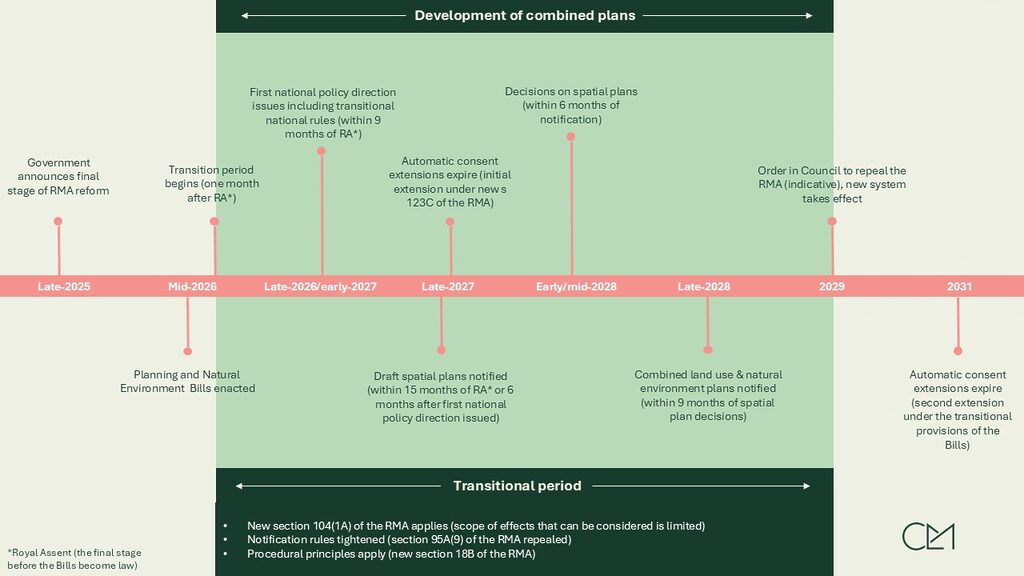
The transitional consenting regime will comprise five core elements:
- Transitional National Rules: These rules will apply to new consent applications during the transition period. There may be rules in the first suite of national instruments, which will guide regional spatial plans, signalled to be finalised by late 2026 / early 2027. If there is any conflict between an existing national environmental standard and a transitional national rule, the new rule will prevail.
- Scope: The Planning Bill inserts section 104(1A) into the RMA which limits the range of effects that can be considered in the resource consent process, even if these effects appear in existing environmental standards or plans. Effects that can no longer be considered include visual amenity, internal / external layout of buildings, landscape, and precedent.
- Notification: the ability to consider “special circumstances” when deciding whether to publicly notify an application is removed.
- Spatial plans to have early effect: Once decisions are made on a new regional spatial plan (i.e. before combined plans are prepared), councils must have regard to it. For example, if a spatial plan identifies a greenfield area for future development, even if that area is not yet zoned in the land use plan, councils must take this into account during the consenting process.
- Procedural Principles: Under new section 18B of the RMA, anyone exercising a power or performing a function must follow specific procedural principles: acting in a timely and cost-effective manner; ensuring actions are proportionate to the scale and significance of the matter; making decisions based on sufficient information, while balancing the cost and practicality of obtaining additional information; and taking an enabling, solutions-focused approach that supports efficient and effective outcomes.
Automatic Consent Extensions
The Government introduced the Resource Management (Duration of Consents) Amendment Act 2025 (Amendment Act) as part of the reform package (it came into force on 17 December 2025). This legislation amends the RMA and provides automatic extensions for certain resource consents and reinstates others that have recently expired.
Under the Amendment Act, any resource consent that was current on 17 December 2025 but due to expire before 31 December 2027 has automatically been extended until that date.
In addition, consents that expired before 17 December 2025 (where the consent holder had lodged a replacement application that remains undetermined) but continuing to operate under section 124 of the RMA have been reinstated and extended to 31 December 2027.
There are exclusions. Consents relating to water cannot be extended beyond a total duration of 35 years, and wastewater consents that have already been extended under sections 139C or 139D of the RMA are not eligible for further extension. The Amendment Act clarifies that ‘deemed’ water consents which were rolled over under the RMA will still expire on 1 October 2026, so those consent holders should be mindful of that date and the need to lodge replacement applications prior to 1 April 2026, if they wish to continue operating under section 124 RMA.
Putting the exclusions to one side, for the consent holders benefiting from automatic extensions, the process is straightforward: no action is required. Where a replacement application has already been lodged, the consent authority must continue processing it unless the applicant formally withdraws. Applicants may choose to withdraw their application at any time before a decision is issued and rely on the extended expiry date of their existing consent.
Local authorities have specific responsibilities under the Amendment Act. New section 123C(7) provides that they must update consent records within six months to reflect the new expiry dates and should inform affected consent holders and applicants as soon as possible.
The Planning Bill introduces further extensions to consent durations (to extend those provided by the Amendment Act). Under these proposed changes, existing consents will be extended to two years beyond the end of the transition period for the new system (Sch 1, cl 17). Based on current timelines, this could mean consents are extended and do not expire until at least 2031. The Natural Environment Bill (Sch 1, cl 1) adopts the same transitional provisions as the Planning Bill.
National Direction
As noted above, a suite of national instruments is expected to be in place by the end of 2026 / early 2027 and will guide consent applications during the transitional period. Earlier this week (on 18 December), the Government released updated national direction under the RMA, introducing three new national instruments and amending six existing ones. These changes will take effect in January 2026.
During the transition period, and until the new system is fully operational, this updated RMA national direction will operate alongside the new suite of instruments introduced under the new system. Where there is any conflict between provisions, the direction under the new system will take precedence.
Final words
The current Bills aim to immediately integrate key elements of the new system into the existing framework. We anticipate that the phased transition will be complex. This is particularly where effects, currently managed under the RMA and through existing plans, are removed from the RMA system, yet councils are still making decisions under old plans (and new plans have not been developed). The rollout may occur region by region. While the transition is designed to be faster, it will still take several years before the new system is fully operational and embedded.
In the meantime, some existing consent holders could have some certainty as consents that would otherwise expire could potentially continue through to 2031 (24 months after the new system is in place).
If you’d like to find out more about the proposed reform and what it might mean for your existing consent or resource consent application; or if you’d like help drafting a submission on the Bills, please contact a member of our Local Government, Resource Management and Regulatory team.