

Subdivision can be an effective way to unlock the value of your property, whether your goal is to sell part of your land, build additional dwellings, create investment opportunities, or transfer land to family members. Subdivision projects involve a number of legal, planning, and technical steps, with different professionals playing important roles throughout the process.
The following guide outlines the key stages involved in a typical subdivision project and explains how those professionals work together to create new lots and ultimately obtain new records of title.
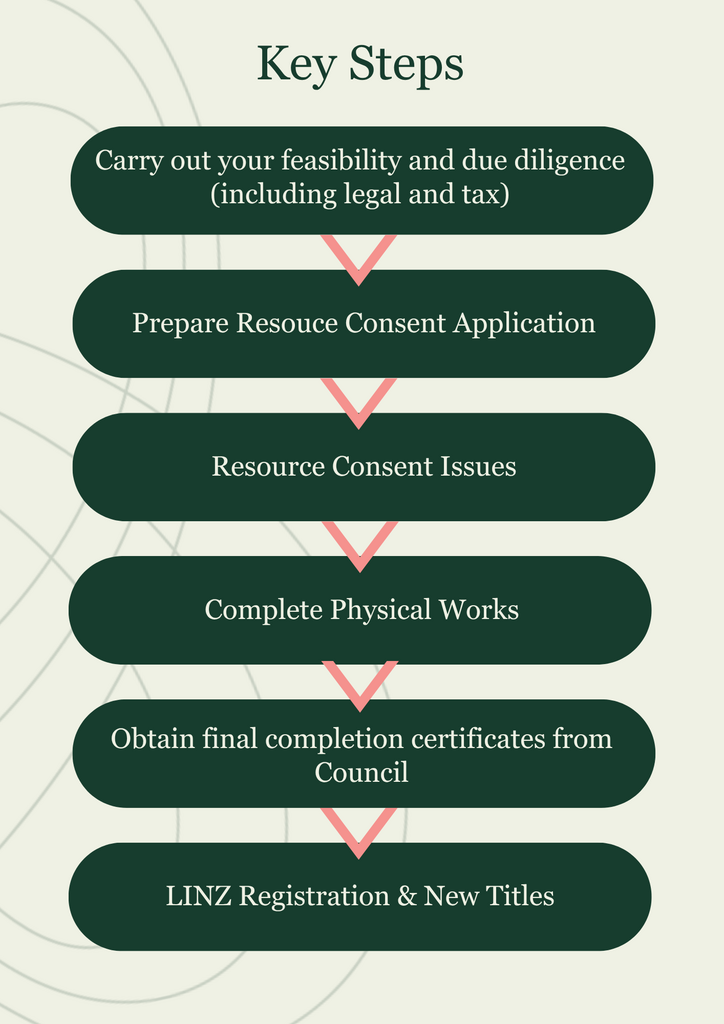
Step 1: Check Whether the Land Can Be Subdivided
Whether your land can be subdivided will depend on factors such as the property’s zoning, site size, any natural hazards that the property is subject to, access arrangements, available services, and the relevant council’s planning rules.
If you are considering a subdivision, the first professional you will usually engage is a surveyor.
Your surveyor can assess whether a subdivision is likely to be feasible, advise how many lots may be able to be created, identify potential issues, and assess whether the proposal is likely to comply with council requirements. They can also advise on access, infrastructure, servicing requirements, and whether other professionals, such as a planner or engineer, should be involved.
While the surveyor assesses whether the subdivision is possible from a physical and planning perspective, it is also important to engage a lawyer to assess whether there are any legal issues that could affect the project.
At Cooney Lees Morgan, we review the property’s title and identify any easements, land covenants, consent notices, rights of way, mortgages, or other encumbrances that may affect the proposed subdivision or future development of the land. We can also advise on ownership structures and whether the current ownership arrangement remains appropriate for any future sale, development, or transfer of the subdivided land.
Identifying these issues early can save significant time and expense. A property may be capable of being subdivided under the relevant planning rules, but existing title restrictions may affect how the land can be used following subdivision or prevent subdivision altogether. For example, a covenant or consent notice may restrict the size, location, or number of dwellings that can be built on a lot.
Undertaking a subdivision can have significant tax implications so it is also important to obtain tax advice early in the process. Your accountant or tax advisor will be able to provide advice on the tax implications of a potential subdivision or future sale of any of the new lots.
Step 2: Prepare and Lodge the Resource Consent Application
Once it has been established that the land is suitable for subdivision, your surveyor will prepare a proposed subdivision plan showing the new lot boundaries (often referred to as a “scheme plan”), access arrangements, and servicing requirements.
This plan forms part of the resource consent application lodged with the relevant council. In most cases, subdivision resource consent is required before a subdivision can proceed.
For more straightforward subdivisions, the surveyor will often manage the application process. However, where more complex planning issues arise, a planner may be engaged to assist with the application and prepare an Assessment of Environmental Effects. Other types of consents (such as land use consent or development approvals may also be required.
The consent process is generally managed by the surveyor and planner (if required). However, before the application is lodged, it can be useful to have a lawyer review the draft subdivision consent application and any resource consent conditions proposed in the application, to help identify any legal issues that may affect the subdivision or the future use, sale, or development of the new lots.
Council will often provide a draft set of consent conditions before issuing the final consent. Where possible we like to review the draft conditions before they are issued. In our experience, it is better to identify any legal issues at that stage and, where appropriate, ask council to amend the proposed conditions before they are formally imposed, as changing conditions after consent has issued can be costly and time-consuming and may require a further application to council.
Step 3: Complete the Resource Consent Conditions
If the resource consent is granted, council will issue a decision setting out conditions that must be satisfied before new titles can be created.
We will review those conditions and advise you on what is required to achieve compliance.
Your surveyor will prepare a more detailed and technical survey plan based on the scheme plan approved as part of the resource consent process. This formal survey plan is called a land transfer plan or a “LT plan” for short. Depending on the nature of the subdivision, there may be engineering, servicing, access, or other physical works that need to be completed. These are typically managed by the surveyor, engineer, and other consultants involved in the project.
This is often the stage where we become more heavily involved. We will prepare and arrange the legal documentation required to complete the subdivision. This may include easements for access and services, land covenants, consent notices, mortgagee consents, and any other documentation required by council, lenders, or the titles office. The formal name for the titles office is Land Information New Zealand, often referred to as “LINZ”.
We also work closely with your surveyor, council, lenders, and other advisers to ensure all legal requirements are met, and the subdivision can continue progressing towards title issue.
Step 4: Obtain Final Council Approval and Create the New Titles
It is important to understand that a resource consent does not itself create new lots. Although council may have approved the subdivision, the new lots do not legally exist until the required final approvals have been obtained and LINZ has issued new records of title.
Once the necessary physical works have been completed and council is satisfied that all resource conditions have been met, council will issue a completion certificate under section 224(c) of the Resource Management Act (often referred to a “224 certificate”).
Your surveyor will also submit the final LT plan to Council for final approval. If Council is satisfied that the LT plan matches the scheme plan approved as part of the subdivision resource consent and any other relevant consent conditions, council will issue a certificate of approval under section 223 of the Resource Management Agreement (often referred to as a “223 certificate”).
Your surveyor will apply for the 223 and 224 certificates from Council on your behalf. Once these certificates have issued, the land transfer plan and associated legal documents are then lodged with LINZ. If LINZ is satisfied that all of the necessary certificates have issued, the LT plan and legal documents comply with all legal requirements then LINZ will then formally “deposit” the LT plan and issue the new titles.
At that point, the subdivision is legally complete.
Step 5: Decide What to Do with the New Lots
Once the new titles have been issued, you can decide whether to sell the newly created lots, develop or build on them, retain them as investments, transfer them to family members, or undertake a further stage of development.
We specialise in “off the plan” sales, townhouse/in-fill developments and act for many prominent developers and builders. We can assist you with the legal aspects of any subsequent sale, development plans or other transactions that may be required following completion of the subdivision.
How Long Does a Subdivision Take?
One of the most common questions property owners ask is how long a subdivision takes. The answer depends on the complexity of the project, council requirements, and whether any engineering or infrastructure works are required.
A straightforward subdivision may be completed relatively quickly (usually between three to 12 months), while more complex projects can take many years from the initial planning stage through to the issue of new titles. Your surveyor will usually be able to provide an indicative timeframe once the scope of the subdivision has been confirmed.
Thinking About Subdividing Your Property?
Every subdivision project is different. The process, costs, and requirements will depend on the characteristics of the land, the proposed development, and the relevant council’s rules.
While surveyors typically lead the technical aspects of a subdivision, legal issues can arise at every stage of the process, from title restrictions and consent requirements through to easements, covenants, lender consents, ownership structures, and the creation of new titles.
Obtaining legal advice early can help identify potential issues before significant time and money is invested in the project.
If you are considering subdividing your property, the Property Team at Cooney Lees Morgan can assist with the legal aspects of the subdivision process from start to finish.